


Encoder
Brands
- Aplex
- Auer
- Balluff
- Beckhoff
- Binder
- Bk Micro
- Detas
- Detas Ev Chargers
- Detas Ultra
- Dis Sensors
- E+E
- Efort
- EL-MicroWave
- Elco
- Eliko
- Elvem
- Exenta
- Fatek
- Gamma System
- Haake
- Hilscher
- Invt
- Kathrein
- Lenord + Bauer
- Leuze
- Matrix Vision
- Microsonic
- Modus
- Novotechnik
- Optris
- Pizzato
- Posital Fraba
- Proxitron
- ReeR
- Senpum
- Siemens
- Stego
- Tekima
- Telco Sensors
- Teleradio
- Tkd
- Toshiba
- Trafag
- Turck Banner
- Weintek
- Werma
Products
- Capacitive Sensor
- Safety Light Curtains
- Pressure Transducer
- Laser scanner
- Cable Entry
- Inverter
- Encoder
- EV Charger
- Power Supplies
- Ultrasonic/Radar Sensor
- PLC
- Industrial Robot
- Industrial PCs
- Real Time Location System
- Photoelectric Sensors
- Cabling/Networking
- Temperature sensors
- Humidity and Flow Sensors
- Online shop
- Vision systems
- Industrial Gateway
- Industry 5.0
- Safety devices
- Mechanical limit switch
- Static Eliminator
- Visual signals
- HMI Panel
- Linear Transducer
- Industrial Barcode Readers
- Brushless Motor
- Inductive sensor
- Industrial Safety Radio Remote Controls
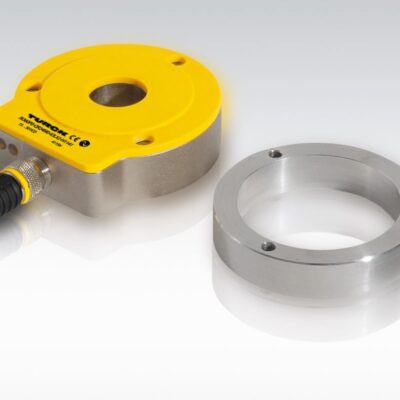
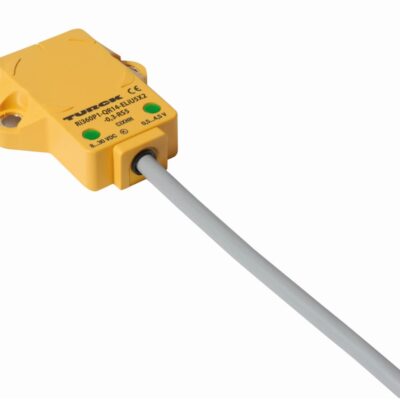
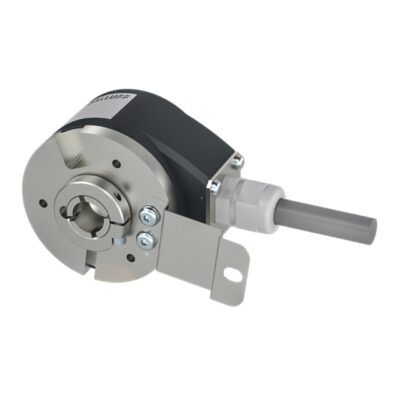
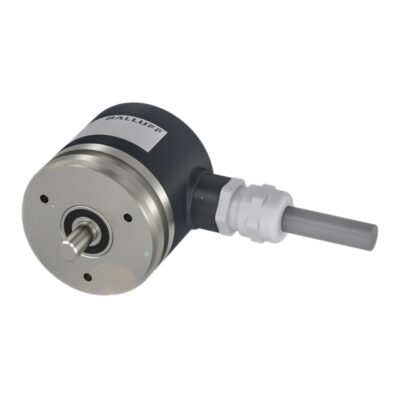
Encoder: what it is and what it is used for
An encoder is a device or process that converts data from one format to another. In position sensing, an encoder is a device capable of detecting and converting mechanical movement into a coded analog or digital output signal. Specifically, an encoder measures position. Meanwhile, speed, acceleration, and direction can be calculated from the position in a linear or rotary movement.
What is an encoder
The encoder is a displacement and speed transducer that transforms angular or linear mechanical movement into a series of digital electrical pulses. Encoders are the ideal solution for accurately determining positions in industrial automation. The encoder therefore converts the angular position of its rotating shaft into a digital electrical signal. These electrical pulses can be used to control the mechanical displacements that generated them and the corresponding displacement speed, acting on actuation devices of any type.
The encoder, also known as a position transducer, generally consists of the following parts:
Mechanical interface
Disk (or optical scale, or magnetic actuator)
Optoelectronic detectors or magnetic sensors
Electronic interface
What an encoder is used for: main applications
The encoder connects to suitable electronic circuits and, with appropriate mechanical connections, is used to reliably measure the number of revolutions, speed, and acceleration. Various techniques and technologies exist for detecting angular movement: photoelectric or optical scanning, magnetic field variation, potentiometric, magnetostrictive, and energy harvesting systems.
Encoders are therefore capable of calculating:
angular displacements, when the rotor is connected to a shaft, it is used to directly detect the angular position of the latter;
linear displacements, when mounted on a rotating shaft that moves a carriage via a screw/nut system or a translating axis via a rack and pinion system;
rotation speeds and accelerations, when the reading equipment is used to directly detect this data.
Encoders come in a vast range of models and are effectively applied worldwide in industrial process controls, industrial robots, machine tools, measuring instruments, plotters, packaging, presses, rolling mills, sheet metal machines, and much more.
How many types of encoders exist
Encoders can be divided into three main categories:
tachometers;
relative (also known as "incremental");
absolute.
In tachometer encoders, a track with black-and-white marks is fixed to the object whose displacement is to be measured. Every time a dark-to-light transition occurs, a sensor detects it and sends a pulse that is recorded by an electronic counter. The measured distance is proportional to the number of pulses measured by the counter. The number of pulses counted per unit of time is proportional to the speed detected during the displacement. For these reasons, the encoder is defined as a tachometer.
Relative or incremental encoders provide information on positions, angles, and rotations. This information is defined by the number of rotary pulses transferred from the encoder to the control for each rotation. The current position is detected by the control by counting these pulses. Thanks to the variety of versions, incremental encoders can be optimally applied to factory, logistics, and process automation applications. For example, incremental encoders send information on the direction of travel and speed of automated guided vehicles (AGVs). The encoder is mounted directly on the motor or on a shaft or return wheel.
Absolute encoders detect the rotary movement of a shaft in angular steps specific to the type. A unique coded pattern is assigned to each angular step. The number of existing coded patterns for one rotation is determined by the resolution capacity. Each pattern
constitutes an unequivocal reference and consequently an absolute position. The electrical output signals encode the exact instantaneous position of the rotor relative to the body; in this way, at any time, a suitable decoding circuit can decode and display the angular position of the shaft under examination. Depending on the interface, additional information such as speed or diagnostic data can also be transmitted. Main applications for absolute encoders include logistics and factory automation for absolute detection of rotary movement, or in palletizing systems to detect the exact position of the gripper. ... read more