


HMI Panel
Brands
- Aplex
- Auer
- Balluff
- Beckhoff
- Binder
- Bk Micro
- Detas
- Detas Ev Chargers
- Detas Ultra
- Dis Sensors
- E+E
- Efort
- EL-MicroWave
- Elco
- Eliko
- Elvem
- Exenta
- Fatek
- Gamma System
- Haake
- Hilscher
- Invt
- Kathrein
- Lenord + Bauer
- Leuze
- Matrix Vision
- Microsonic
- Modus
- Novotechnik
- Optris
- Pizzato
- Posital Fraba
- Proxitron
- ReeR
- Senpum
- Siemens
- Stego
- Tekima
- Telco Sensors
- Teleradio
- Tkd
- Toshiba
- Trafag
- Turck Banner
- Weintek
- Werma
Products
- Capacitive Sensor
- Safety Light Curtains
- Pressure Transducer
- Laser scanner
- Cable Entry
- Inverter
- Encoder
- EV Charger
- Power Supplies
- Ultrasonic/Radar Sensor
- PLC
- Industrial Robot
- Industrial PCs
- Real Time Location System
- Photoelectric Sensors
- Cabling/Networking
- Temperature sensors
- Humidity and Flow Sensors
- Online shop
- Vision systems
- Industrial Gateway
- Industry 5.0
- Safety devices
- Mechanical limit switch
- Static Eliminator
- Visual signals
- HMI Panel
- Linear Transducer
- Industrial Barcode Readers
- Brushless Motor
- Inductive sensor
- Industrial Safety Radio Remote Controls
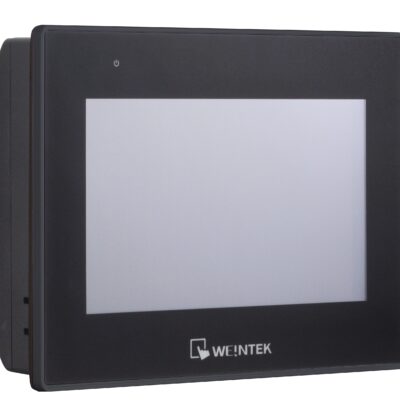
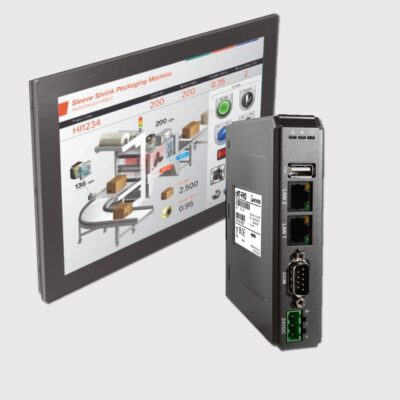
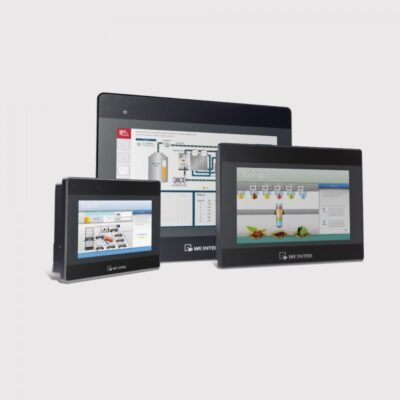
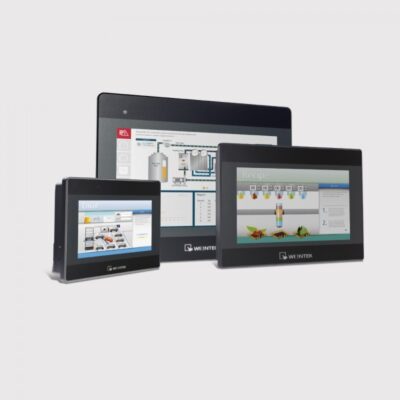
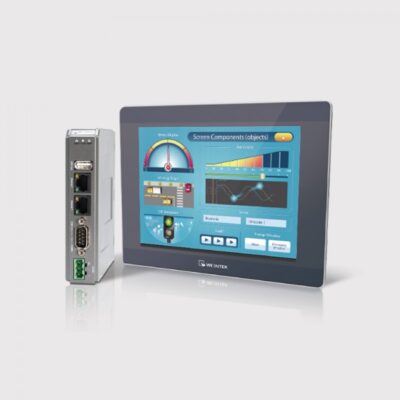
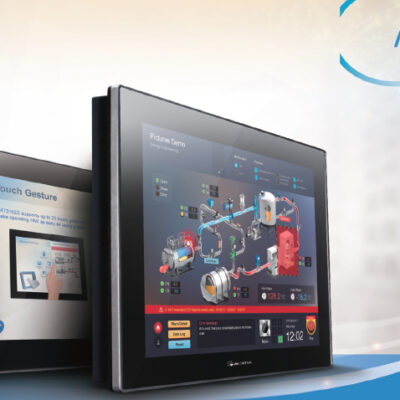
HMI Panel: The Human-Machine Interface Device for Industrial Automation
The HMI panel is the device that allows the operator to communicate directly and intuitively with industrial machinery or plants.
Thanks to this interface, humans and machines exchange data quickly and safely, improving production process control and operational efficiency.
HMI Panel: Meaning and How It Works
HMI stands for Human Machine Interface, or human-machine interface.
It is an operator panel or screen that allows the user to interact with a machine, system, or industrial software through an intuitive graphical interface.
Today, HMI panels are used in numerous sectors: automotive, food, pharmaceutical, construction, energy, and logistics. Engineers and system integrators use them to monitor, control, and optimize plants and machinery.
HMI Panel: Role in the Automation System
The HMI panel represents one of the most current topics in the field of industrial automation.
With the ongoing technological evolution, data is playing an increasingly central role in industrial processes; companies use HMI panels in this way, and human-machine interfaces are destined to grow in importance.
The following will be used more frequently:
advanced data analysis
artificial intelligence to obtain as much information as possible from data.
By now, the majority of companies in Industry 4.0 are already starting their transition toward high-performance HMIs that help users focus on the most important information, such as:
understanding available data
preventing information overload
Industrial companies are increasingly adopting:
multi-touch screens
remote monitoring
cloud-based systems
Therefore, an HMI panel is a fundamental device for monitoring and control operations on machinery and plants in the industrial sector.
A human-machine interface device is a flexible and intelligent solution to the challenges of Industry 4.0:
it can be integrated at a higher network level
it meets the continuous demand for data acquisition and processing
The HMI panel provides the operator with all the tools necessary to control the production process because it translates a huge amount of complex data into human-accessible information.
Placing this statement in the world of industrial automation, it is clear that the more high-performing and easy to use the HMI is, the more efficient and profitable the work becomes.
HMI Panel: Advantages in the Industrial Field
The HMI panel, a human-machine interface device, provides a series of benefits in the industrial field:
better visibility: a high-performance HMI panel offers better visibility into operations at all times. In fact, it allows you to see plant performance on a single dashboard, ensuring better productivity over time and responsiveness to emergencies;
greater efficiency: since the HMI panel provides constant access to real-time data, it can be used to monitor production and adapt it to current needs. In fact, operator panels allow you to view data and combine it with data analysis technologies that help identify areas for operational efficiency improvement;
reduced downtime: the HMI panel allows you to see any problems on a central dashboard, making it possible to resolve them more quickly and reduce downtime. It also allows for the identification and prevention of future mechanical problems, intervening before risking substantial downtime. Therefore, an HMI panel is fundamental if you want to implement predictive and preventive maintenance;
greater ease of use: the HMI panel allows users to view and understand data and the instrumentation to control it. It presents data through images, tables, and other representations;
unified system: the HMI panel also allows for the control of all plants with the same system. Furthermore, data can also be viewed in a single container to enjoy a better overview, and all users can receive relevant updates in real time.
... read more