


PLC
Brands
- Aplex
- Auer
- Balluff
- Beckhoff
- Binder
- Bk Micro
- Detas
- Detas Ev Chargers
- Detas Ultra
- Dis Sensors
- E+E
- Efort
- EL-MicroWave
- Elco
- Eliko
- Elvem
- Exenta
- Fatek
- Gamma System
- Haake
- Hilscher
- Invt
- Kathrein
- Lenord + Bauer
- Leuze
- Matrix Vision
- Microsonic
- Modus
- Novotechnik
- Optris
- Pizzato
- Posital Fraba
- Proxitron
- ReeR
- Senpum
- Siemens
- Stego
- Tekima
- Telco Sensors
- Teleradio
- Tkd
- Toshiba
- Trafag
- Turck Banner
- Weintek
- Werma
Products
- Capacitive Sensor
- Safety Light Curtains
- Pressure Transducer
- Laser scanner
- Cable Entry
- Inverter
- Encoder
- EV Charger
- Power Supplies
- Ultrasonic/Radar Sensor
- PLC
- Industrial Robot
- Industrial PCs
- Real Time Location System
- Photoelectric Sensors
- Cabling/Networking
- Temperature sensors
- Humidity and Flow Sensors
- Online shop
- Vision systems
- Industrial Gateway
- Industry 5.0
- Safety devices
- Mechanical limit switch
- Static Eliminator
- Visual signals
- HMI Panel
- Linear Transducer
- Industrial Barcode Readers
- Brushless Motor
- Inductive sensor
- Industrial Safety Radio Remote Controls
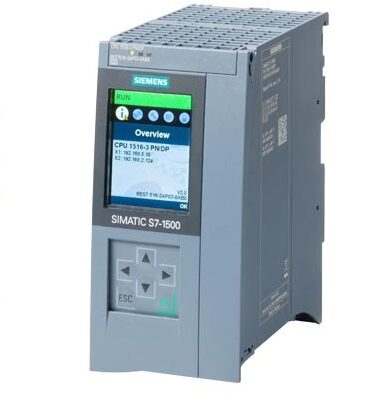
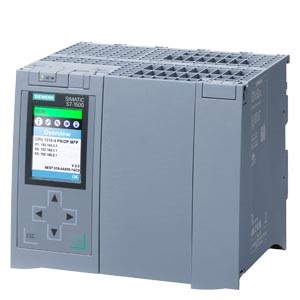
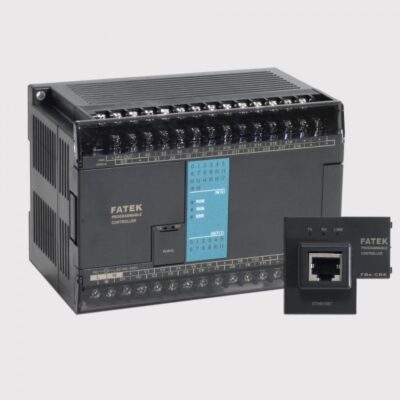
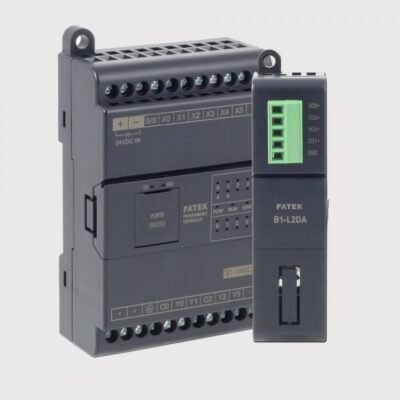
PLC: Features and Operation
Also known as a “Programmable Logic Controller” (PLC), it is an electronic instrument for industry, a computer that is programmed using a specific language and is capable of executing instructions autonomously.
This is possible through interaction with a control circuit via input and output devices.
PLC: Definition and Meaning
A PLC, an acronym for Programmable Logic Controller, refers to an electronic device designed to monitor and regulate machines and production processes in industrial environments using automation technologies.
PLCs are used as stand-alone systems to optimize industrial processes intelligently and independently.
It is essentially a programmable electronic system.
Control instructions are saved on the PLC's programmable memory, allowing the device to perform specific functions and tasks.
To program the PLC, a PC equipped with specific software is required to perform a simulation once the coding is complete.
With a PLC, it is possible to control various types of machines and processes through digital and analog input and output modules.
Thanks to its evolution over time, the PLC is now used for the control and management of any type of industrial automation, machinery, plants, and even in the HVAC sector (heating, ventilation, irrigation, alarms, etc.).
PLC: Components and Structure
A PLC is primarily composed of several hardware elements:
The Central Processing Unit (CPU): acts as the coordinator of the PLC's activities. It interprets and executes the program, performing arithmetic operations and functional checks. There are also circuits attached to the CPU, including:
the operating mode selector, which determines the PLC's operating mode (programming or execution);
the self-diagnostic circuit, which repeatedly checks for the safety conditions necessary for the execution of the user program;
the watchdog circuit, which interrupts PLC activity when self-diagnosis detects anomalies.
I/O cards
Communication ports
The power supply: can be integrated into the PLC or external. It provides the internal circuits of the device with the correct electrical current, maintaining insulation and safety conditions;
Memories: there are two types of memory, RAM and ROM. RAM is a volatile memory for writing and reading the data of the program to be executed. ROM is a non-volatile memory for storing the system program.
Input and output devices: through these devices, the PLC interacts with the circuit to be controlled. Interaction occurs via analog or ON-OFF signals.
In the first case, numerically variable values are transmitted and converted into digital signals; in the second case, signals can only assume two distinct values, such as an open or closed contact.
Programming devices: the equipment for drafting, compiling, and sending user programs to the PLC memory. Two programming modes can be distinguished:
online: the program is entered directly into the PLC;
offline: the program is stored on an EPROM memory which is only transferred later.
In PLCs, control is exclusively software-based. They have their own operating system and often include other software. They do not have their own CPU, so they use the PC processor instead. For this reason, they must share the processor with the PC operating system (and perhaps other applications). This factor can affect performance when the workload is high.
Finally, there are compact and board-level PLCs. In a compact PLC, all components are located on a single printed circuit board in a single housing. Board-level PLCs are used directly as PCI plug-in cards and are intended for specific tasks, such as storing production data.
PLC: Applications and Advantages of the Device
PLCs are increasingly used in all industrial sectors. They are widely used, for example, in the manufacturing industry, the food sector, and building supervision.
Below are some basic examples of PLC usage:
medical machine applications;
traffic control;
packaging machines;
machine tools;
production plants;
elevators and escalators.
In its various applications, the PLC offers numerous advantages, replacing common electromechanical and electronic circuits in wired logic (WLC, Wired Logic Control):
cost: the PLC has become available over time at increasingly lower prices and smaller sizes;
flexibility: it is possible to adapt the system to the process without revolutionizing the physical configuration (hardware), but only by acting on the program (software) created for its exclusive operation;
versatility: the PLC adapts to any circuit solution, as its operation depends exclusively on the set program (software);
reliability: the electronic components of the PLC do not require special maintenance. Self-diagnostic functions are available, along with the possibility of interacting with management computers capable of monitoring activity;
reuse: the PLC can be reused many times for the same application or for new systems.
... read more