


Industrial Robot
Brands
- Aplex
- Auer
- Balluff
- Beckhoff
- Binder
- Bk Micro
- Detas
- Detas Ev Chargers
- Detas Ultra
- Dis Sensors
- E+E
- Efort
- EL-MicroWave
- Elco
- Eliko
- Elvem
- Exenta
- Fatek
- Gamma System
- Haake
- Hilscher
- Invt
- Kathrein
- Lenord + Bauer
- Leuze
- Matrix Vision
- Microsonic
- Modus
- Novotechnik
- Optris
- Pizzato
- Posital Fraba
- Proxitron
- ReeR
- Senpum
- Siemens
- Stego
- Tekima
- Telco Sensors
- Teleradio
- Tkd
- Toshiba
- Trafag
- Turck Banner
- Weintek
- Werma
Products
- Capacitive Sensor
- Safety Light Curtains
- Pressure Transducer
- Laser scanner
- Cable Entry
- Inverter
- Encoder
- EV Charger
- Power Supplies
- Ultrasonic/Radar Sensor
- PLC
- Industrial Robot
- Industrial PCs
- Real Time Location System
- Photoelectric Sensors
- Cabling/Networking
- Temperature sensors
- Humidity and Flow Sensors
- Online shop
- Vision systems
- Industrial Gateway
- Industry 5.0
- Safety devices
- Mechanical limit switch
- Static Eliminator
- Visual signals
- HMI Panel
- Linear Transducer
- Industrial Barcode Readers
- Brushless Motor
- Inductive sensor
- Industrial Safety Radio Remote Controls
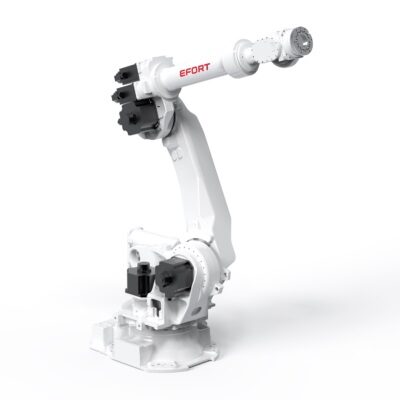
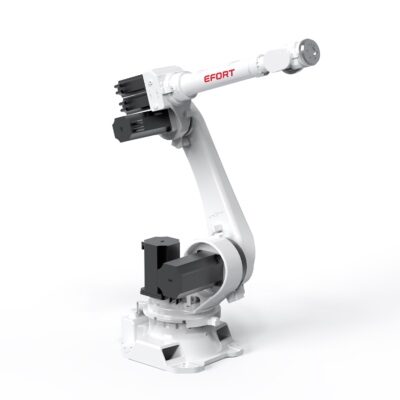
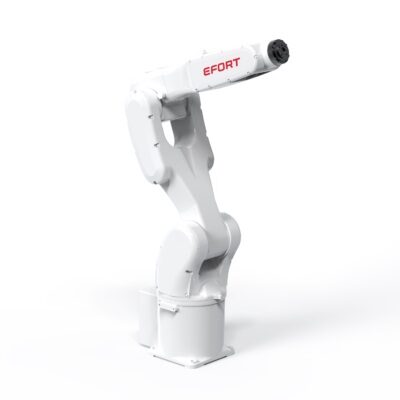

Industrial robot: definition and types
The industrial robot is a type of robot used in industrial production to make it faster and of higher quality.
Industrial robot: definition
An industrial robot refers to a multifunctional and reprogrammable structure, automatically controlled, which can be fixed in place or mobile for use in industrial automation applications. Industrial robots are designed to perform a wide variety of different tasks. Furthermore, in recent years, industrial robots have continuously evolved, becoming increasingly compact and high-performing.
In the industrial field, robots perform various tasks, ensuring the safety and health of workers. Among the most common processes carried out by industrial robots, we find:
drilling;
palletizing;
storage;
CNC tending;
grinding;
milling;
painting;
enameling;
laser cutting.
The industrial robot is equipped with a mechanical structure that changes based on the function the robot is assigned to.
Industrial robot: main types
In the industrial sector, industrial robots can be divided into four categories:
Cartesian: an industrial robot that moves along linear or rotating Cartesian axes. This industrial robot is very easy to control. Each axis on which the robot moves corresponds to a degree of freedom;
human arm and hand movements: suitable for handling and assembly operations on diverse coordinates;
SCARA (Selective Compliant Assembly Robot Arm): an industrial robot designed for fast and precision operations. The reliability of this industrial robot is guaranteed by the simplicity of its structure;
Delta: this type of industrial robot increases the speed and versatility of handling operations for small parts in sectors such as pharmaceuticals, electronics, and food.
Depending on their industrial applications, robots are classified into three levels:
first-level industrial robot: a robot whose purpose is to perform a specific task consecutively and repetitively with a high degree of precision. Programming is done through specific software.
second-level industrial robot: these are much more flexible robots, capable of autonomously adapting to changes in operating conditions;
third-level industrial robot: these are robots capable of making decisions autonomously (not foreseen by the manufacturer) using neural networks. Currently, these types of robots are not yet used in industrial settings because they are very complex.
Industrial robot: how to choose the most suitable one
The use of an industrial robot within the production chain requires a series of evaluations related to the nature of the product manufactured, production times, and finally aesthetics.
Specifically, it is necessary to take into account the following aspects:
type of object to be handled;
type of process to be performed;
volume and weight of the object on which the operation must be carried out;
quality and yield that the product must have;
internal space required for the robot's movement;
available budget.
... read more